
Laser Beam Shaping Using Optical Arrays for Industrial Laser Applications
Beam shaping plays a critical role in modern high-power laser processing. By redistributing laser energy into specific spatial profiles, beam shaping optics can significantly improve processing efficiency, energy uniformity, and manufacturing quality.
This study investigates several optical array structures used for laser beam shaping, including cylindrical lens arrays, cylindrical mirror arrays, circular mirror arrays, and conical lens arrays. The simulations evaluate how different array parameters influence the final focused spot distribution under various incident beam conditions.
Unless otherwise specified, all simulations use a laser wavelength of 0.908 μm.
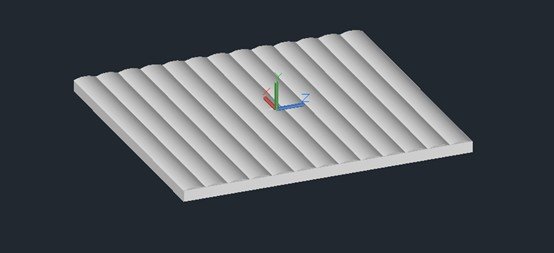
(1) 3D model of cylindrical lens array
1. Cylindrical Lens Arrays
The first configuration investigated is the cylindrical lens array, which is commonly used for transforming beam profiles in industrial laser systems.
A cylindrical lens array consists of multiple micro-cylindrical lenses arranged in parallel rows. By combining these elements, the incoming beam can be spatially redistributed before reaching the focusing optics.
Two theoretical configurations exist:
Concave cylindrical lens arrays
Convex cylindrical lens arrays
In this study, the simulations focus on convex cylindrical lens arrays, while concave arrays exhibit similar optical behavior.
Focusing Characteristics
For a 2000 W elliptical collimated beam (10 mm × 16 mm) passing through a cylindrical lens array and subsequently focused using a double air-spaced compound lens, the resulting focal distribution forms a line-shaped spot.
Extensive simulations show that the line spot size depends primarily on:
The width of each micro-cylindrical lens
The curvature radius of the lens surface
Key observations include:
When the lens width is constant, increasing the curvature radius produces a shorter focal line.
When the curvature radius is fixed, reducing the lens width also produces a shorter focal line.
These parameters provide flexibility when designing beam shaping systems for line-based laser processing applications.
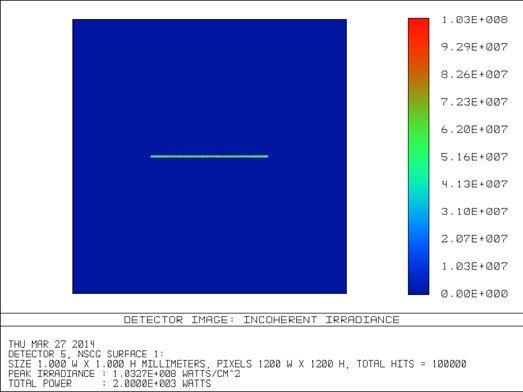
- (2) Focusing spot using a combination of cylindrical lens array and double air gap mirror.
Influence of Incident Beam Shape
Using the same cylindrical lens array configuration, a 16 mm circular Gaussian beam was also simulated.
The results indicate that:
The geometric shape of the focused spot is largely independent of the source beam shape.
However, the energy distribution inside the spot is affected by the incident beam profile.
This demonstrates that cylindrical lens arrays primarily determine the spatial distribution geometry, while the incoming beam influences intensity distribution.
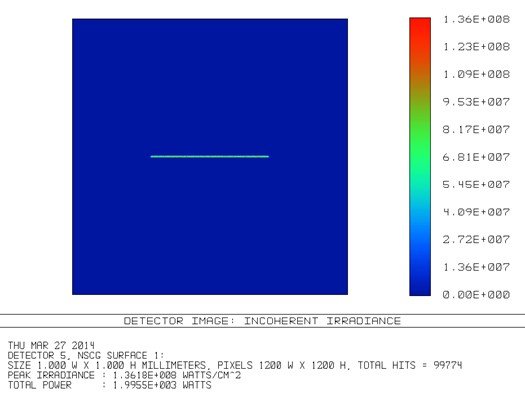
(3) Focusing of circular light spots
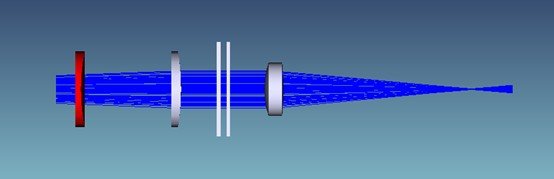
(4) Simplified diagram of the structure of an elliptical cylindrical lens collimating the fast and slow axes, a mutually perpendicular cylindrical lens array, and a double air gap combination lens.
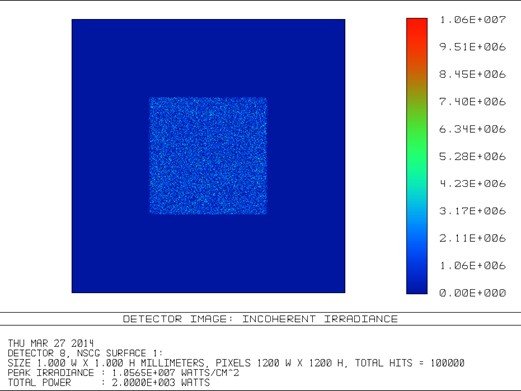
(5) Elliptical cylindrical lens collimating fast and slow axes + mutually perpendicular cylindrical lens array + double air gap combination lens focusing spot
Crossed Cylindrical Lens Array Configuration
A more advanced configuration uses:
Fast-axis and slow-axis elliptical cylindrical lenses for collimation
Two orthogonal cylindrical lens arrays
A double air-spaced focusing lens
In this optical arrangement:
The first cylindrical lens is positioned vertically with a 200 mm focal length.
The second cylindrical lens is placed horizontally with a 250 mm focal length.
The divergence angle of the elliptical beam primarily affects the lens aperture size selection, while the placement principle is similar to that of a point-source collimation system. The optical path difference introduced by lens thickness must also be considered.
Interestingly, when cylindrical lens arrays are used, replacing elliptical cylindrical lenses with standard cylindrical lenses has minimal influence on the final spot distribution. This is because the energy distribution of the focused spot is mainly determined by the array structure and focusing optics.
Simulation results show that this configuration produces a square-shaped focused spot with uniform energy distribution.
Key characteristics include:
The spot width remains consistent with previous configurations.
The final spot becomes square rather than linear.
The focused spot size is largely independent of the distance between the cylindrical lens arrays.
Extensive simulations confirm that different combinations of cylindrical lens arrays can generate square spots with adjustable dimensions, while maintaining uniform energy distribution along both axes.
This property makes cylindrical lens arrays particularly useful for applications requiring rectangular or square flat-top beams.
For high-power laser systems, reflective structures may be preferred due to their superior thermal handling capability. This leads to the use of cylindrical mirror arrays.
2. Cylindrical Mirror Arrays
Cylindrical mirror arrays provide optical performance similar to cylindrical lens arrays while offering improved durability for high-power laser systems.
A single cylindrical mirror can reflect parallel light to form a line-shaped focal spot after focusing.
When two cylindrical mirror arrays are placed orthogonally, rectangular or square beam profiles can be generated.
In the simulation, a 2000 W elliptical beam with divergence is first collimated using fast-axis and slow-axis cylindrical lenses, followed by beam shaping with crossed cylindrical mirror arrays and focusing through a double air-spaced compound lens.
The cylindrical mirrors have the following characteristics:
Reflection angle: 45°
Mirror surface: concave
Identical micro-mirror width and curvature parameters
Several parameter combinations were analyzed.
For example:
Micro-mirror width: 2 mm
Curvature radius: 300 mm
The resulting focused spot size is:
1.0064 mm × 1.4070 mm
Simulation results indicate that under this configuration, the spot aspect ratio follows the relationship of the cosine of the reflection angle or its reciprocal.
Other parameter combinations were also simulated:
| Mirror Width | Curvature Radius | Spot Size |
|---|---|---|
| 2 mm | 200 mm | 3.052 mm × 4.272 mm |
| 2 mm | 1000 mm | 0.3112 mm × 0.4266 mm |
| 1 mm | 1000 mm | 0.1830 mm × 0.2678 mm |
Despite the variation in spot size, the energy distribution remains highly uniform in most cases.
Additional observations include:
All focal spots lie on the same focal plane.
The orientation of the mirror arrays (horizontal-vertical or vertical-horizontal) does not affect the final spot shape.
These characteristics make cylindrical mirror arrays highly suitable for high-power beam shaping applications.
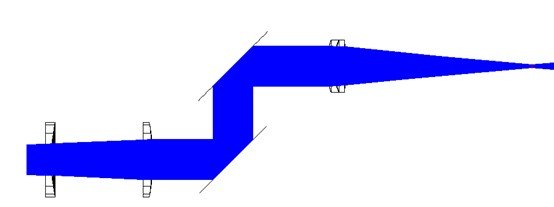
(6) Schematic diagram of focusing combination of elliptical cylindrical lens fast and slow axis collimation + mutually perpendicular cylindrical mirror array + double air gap combination mirror.
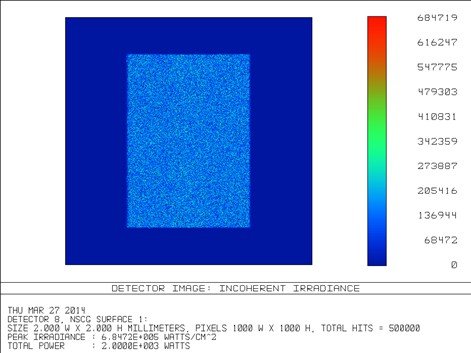
(7) Distribution of focused light spot with a width of 2mm and a radius of curvature of 300mm
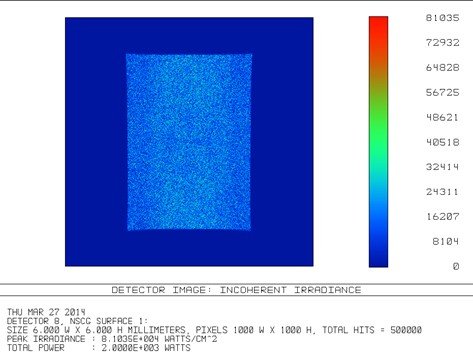
(8) The distribution of the focused spot with a width of 2mm and a radius of curvature of 200mm
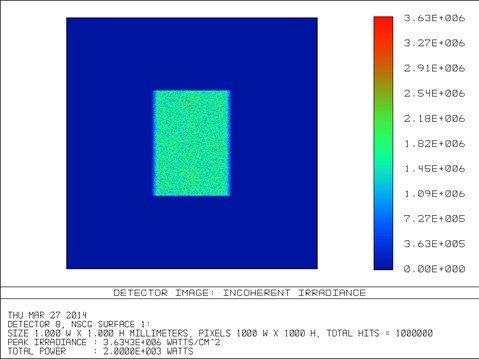
(9) Distribution of focused light spot with a width of 2mm and a radius of curvature of 1000mm
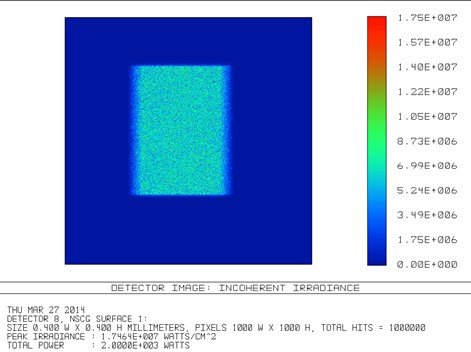
(10) Distribution of focused light spot with a width of 1 mm and a radius of curvature of 1000 mm
3. Circular Mirror Arrays
Circular reflective arrays were also investigated.
The optical configuration includes:
Elliptical beam input
Elliptical cylindrical lens collimation
Circular reflective micro-mirror array
Double air-spaced focusing lens
Each micro-mirror in the circular array consists of:
A square reflective region
A spherical protruding surface
Simulations indicate that to obtain a square output beam, the aspect ratio of each micro-mirror must satisfy a relationship related to the cosine of the reflection angle.
By adjusting:
Mirror aspect ratio
Mirror size
Surface curvature radius
different focused spot sizes can be generated.
The optical behavior is consistent with the transmissive optical array configuration.
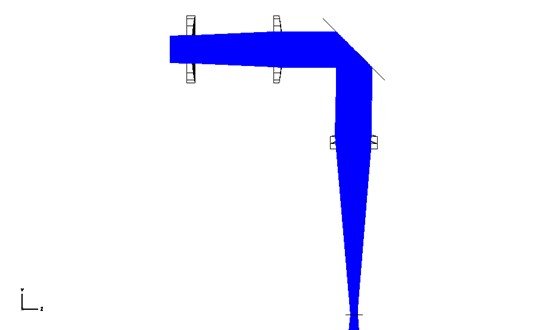
(11) Simplified diagram of elliptical cylindrical lens collimation + circular reflection array + double air gap combination mirror.
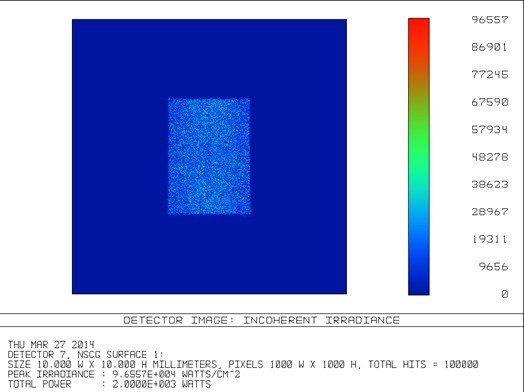
(12) Circular mirror array corresponds to the focused light spot
4. Conical Lens Arrays
Finally, conical lens arrays were simulated using both elliptical and circular incident beams.
The resulting focused spot from a conical lens array forms a ring-shaped distribution.
Key findings include:
The ring pattern is largely independent of the incident beam shape.
The focal distribution is strongly related to the focusing lens focal length.
Conical lens arrays are therefore suitable for applications requiring annular beam distributions.
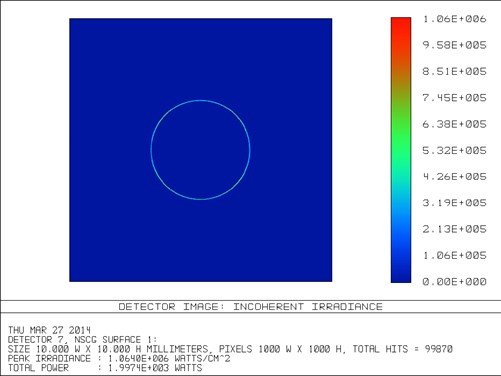
(13) Conical lens array corresponds to the focused light spot
Conclusion
This study demonstrates that various optical array configurations can effectively reshape laser beam profiles for industrial applications.
Key conclusions include:
Cylindrical lens arrays generate line or square beam profiles depending on the arrangement.
Cylindrical mirror arrays provide similar beam shaping capabilities with improved high-power tolerance.
Circular mirror arrays allow flexible generation of square or rectangular beam profiles.
Conical lens arrays produce annular beam distributions.
By carefully selecting array geometry and optical parameters, laser systems can achieve highly uniform energy distributions and customized beam profiles, enabling improved performance in applications such as laser cladding, surface hardening, and material processing.