
Introduction
With the rapid development of high-power fiber lasers, laser processing technologies such as cutting, welding, cladding, and surface hardening are widely used in modern manufacturing. In many industrial applications, the natural output beam profile of a fiber laser is not always optimal for the intended process. As a result, laser beam shaping has become an important optical technique used to modify the spatial energy distribution of a laser beam.
Laser beam shaping refers to the process of transforming the original laser beam into a desired intensity distribution or spot geometry. Typical beam profiles include circular, rectangular, square, or line-shaped spots depending on the application requirements.
Proper beam shaping can significantly improve processing quality, energy efficiency, and thermal uniformity. Therefore, beam shaping optics are widely used in industrial laser systems.
Why Beam Shaping Is Important in Industrial Laser Processing
The beam profile directly affects how laser energy interacts with the material surface. Different manufacturing processes require different laser spot shapes.
For example:
Laser cutting typically requires a highly concentrated circular spot to achieve high power density.
Laser welding often benefits from stable and symmetric beam profiles.
Laser cladding may require a larger and more uniform energy distribution to ensure stable melt pool formation.
Laser surface hardening often uses rectangular or line-shaped beams to uniformly heat large surface areas.
Without proper beam shaping, the laser energy distribution may be uneven, resulting in process instability, excessive heat concentration, or inconsistent treatment quality.
Beam shaping optics allow engineers to control the spot size, shape, and intensity distribution, enabling more precise and efficient laser processing.
Common Laser Beam Shapes in Industrial Applications
Several beam geometries are commonly used in industrial laser processing.
Circular Beam
The circular beam is the most common laser spot profile. It is typically used in laser cutting and welding applications because it provides a concentrated energy distribution at the focal point.
Circular beams are usually generated by standard collimation and focusing optics.
Rectangular Beam
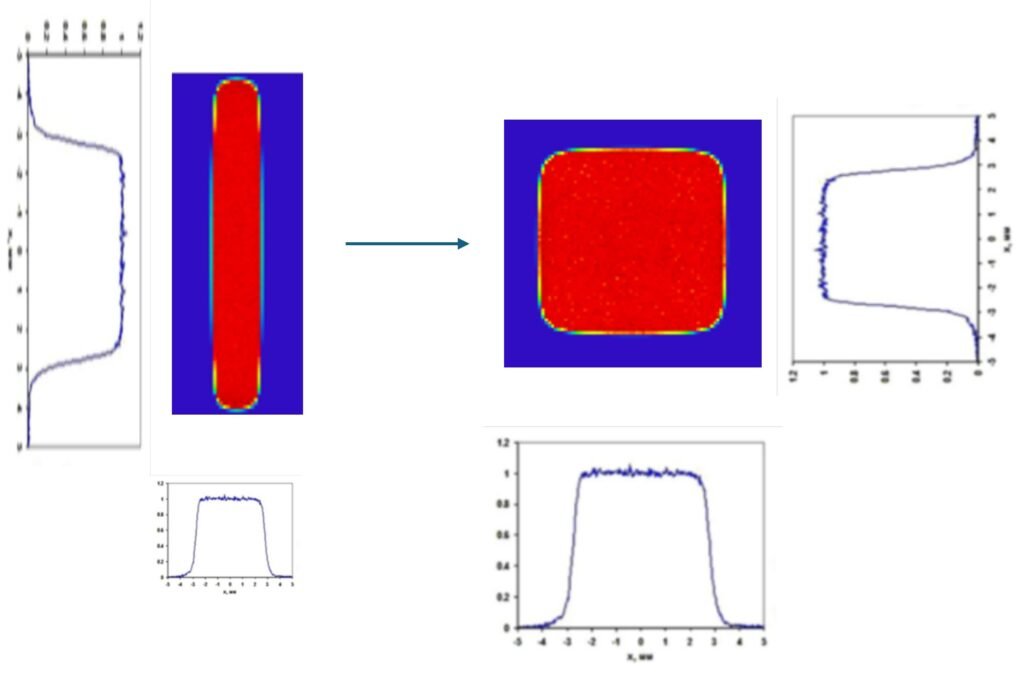
Rectangular beam profiles are frequently used in laser surface hardening and heat treatment. Compared with circular beams, rectangular spots can distribute laser energy more evenly across a larger processing area.
Rectangular beams can be generated using cylindrical lenses or beam integrator optics.
Line Beam
Line-shaped laser beams are used for applications such as:
laser annealing
laser heat treatment
surface modification
These beams are typically produced using cylindrical lens systems that compress the beam in one axis.
Top-Hat Beam (Uniform Beam)
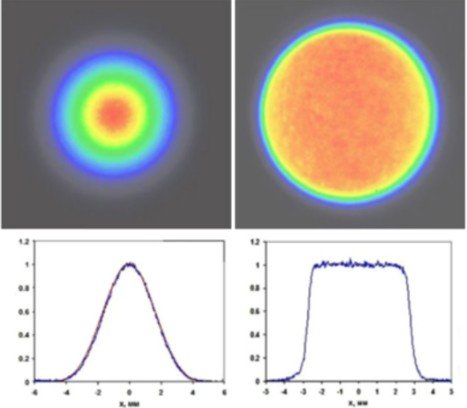
In some applications, especially laser cladding and coating processes, a uniform intensity distribution is preferred. This type of beam is often called a Top-Hat beam.
Top-hat beam shaping systems aim to eliminate the Gaussian energy peak and produce a flat intensity profile.
Common Beam Shaping Methods
Several optical techniques can be used to modify laser beam profiles in industrial systems.
Cylindrical Lens Beam Shaping
Cylindrical lenses are one of the most commonly used beam shaping components. Unlike spherical lenses, cylindrical lenses focus light in only one axis.
By combining multiple cylindrical lenses, engineers can expand or compress the beam in different directions. This method is widely used to convert elliptical or rectangular beams into desired spot geometries.
Cylindrical lens systems are commonly used in:
rectangular beam shaping
line beam generation
laser surface hardening systems
Beam Integrator Optics
Beam integrators are optical components designed to homogenize the energy distribution of a laser beam. These systems redistribute the laser intensity to produce a more uniform beam profile.
Beam integrators are commonly used in applications that require uniform heating, such as:
laser hardening
laser annealing
laser heat treatment
Reflective beam integrators using copper mirrors are often used in high-power laser systems because of their excellent thermal stability and high reflectivity.
Micro Lens Arrays
Micro lens arrays consist of many small lenses arranged in a grid pattern. These optical elements divide the incoming beam into multiple sub-beams, which then overlap to create a uniform intensity distribution.
Micro lens arrays are commonly used in:
beam homogenization
laser illumination systems
semiconductor laser processing
Diffractive Optical Elements (DOE)
Diffractive optical elements use micro-structured surfaces to reshape laser beams through diffraction. These elements can produce complex beam profiles with high precision.
DOE beam shaping is widely used in applications requiring customized beam patterns. However, these optical components can be sensitive to wavelength changes and alignment errors.
Applications of Beam Shaping in Industrial Lasers
Laser beam shaping technology is widely used in modern laser processing systems.
Typical applications include:
fiber laser cutting systems
laser welding equipment
laser cladding heads
laser surface hardening systems
additive manufacturing systems
In laser cladding and surface treatment processes, beam shaping plays an essential role in achieving stable melt pools and uniform material deposition.
6. Axicon and Parabolic Mirror Optical System
In the configuration shown in Figure (3):
the first axicon lens is concave
the second axicon lens is convex
both axicons have equal absolute cone angles.
The beam is expanded into an annular beam after passing through the two axicons.
For structural layout purposes, a 90° mirror may again be used to redirect the beam before it reaches a 90° off-axis parabolic mirror with a central hole, where the final focusing occurs.
Powder or wire feeding can then be implemented through the central aperture.
Good cooling design is essential for this optical system.
By adjusting the distance between the two axicons, the system can control:
the size of the annular beam
the diameter of the hollow region.
Conclusion
Laser beam shaping is a critical technology in modern industrial laser processing. By modifying the spatial distribution of laser energy, beam shaping optics enable engineers to optimize laser performance for different applications.
Various optical techniques—including cylindrical lenses, beam integrators, micro lens arrays, and diffractive optics—can be used to achieve different beam profiles. The selection of the appropriate beam shaping method depends on the specific processing requirements, laser parameters, and optical system design.
As industrial laser applications continue to expand, advanced beam shaping technologies will play an increasingly important role in improving efficiency, precision, and process stability.