
Introduction
High-power laser processing heads are critical components in modern industrial laser systems. Their mechanical design directly affects system stability, beam accuracy, cooling performance, and long-term reliability.
In high-power applications such as laser cutting, laser cladding, and laser heat treatment, the mechanical structure must not only support the optical system but also ensure proper thermal management and environmental protection.
A well-designed laser processing head integrates precision mechanics, thermal engineering, and modular assembly concepts to achieve stable and efficient laser operation.
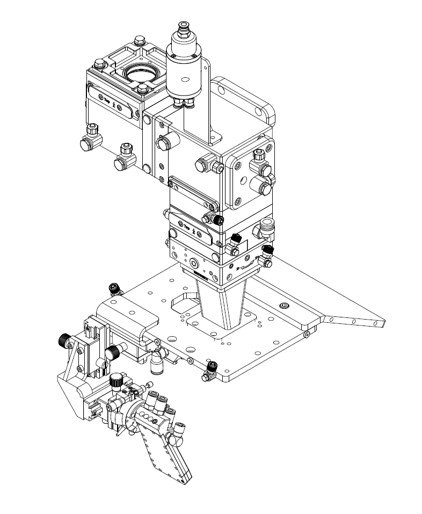
Figure(1): Mechanical wireframe model of a reflective copper mirror laser head.
The structure shows the internal layout of a reflective optical system where copper mirrors are used to guide and focus the laser beam. Reflective optical designs are widely used in high-power laser processing due to their superior thermal resistance and reduced optical absorption. The mechanical framework integrates precision mirror mounts, cooling channels, and protective window structures to ensure accurate optical alignment and reliable long-term operation.
Figure(2)
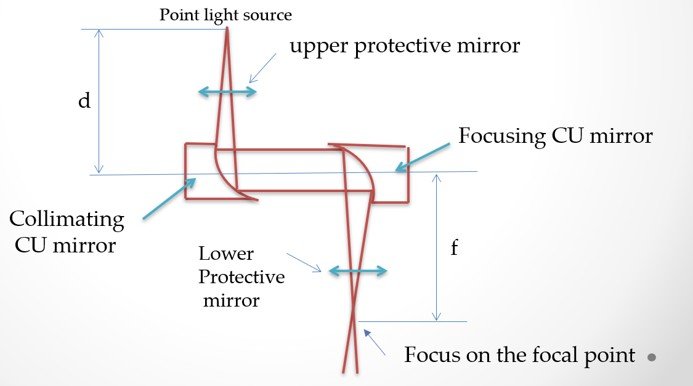
Typical optical path diagram of a copper mirror reflective laser head showing beam reflection and focusing configuration.
Typical Optical Path of a Reflective Copper Mirror Laser Head
The following diagram illustrates the typical optical path used in a reflective copper mirror laser head. In this optical configuration, the laser beam enters the processing head and is guided through a series of precisely positioned reflective mirrors before reaching the final focusing position.
Reflective optical systems are widely used in high-power laser applications because they avoid the absorption losses associated with transmissive optics. Copper mirrors, in particular, are preferred due to their excellent thermal conductivity and high reflectivity for infrared laser wavelengths.
In this design, the mirrors redirect the beam along a controlled path while maintaining beam quality and alignment. The mechanical structure of the laser head ensures that each mirror remains precisely positioned relative to the optical axis, which is essential for stable beam delivery and accurate focusing.
Such reflective optical configurations are commonly used in industrial laser systems for applications including laser cladding, laser heat treatment, and large-area surface processing, where high power handling capability and thermal stability are critical.
Reflective optical systems have been widely used in high-power laser processing equipment. Several companies have developed advanced reflective laser head designs based on precision copper mirrors. For example, solutions developed by Kugler GmbH demonstrate high precision mirror machining and optical alignment capabilities. Readers interested in reflective laser optical systems can refer to their technical materials for additional insight.
Further Reading
For additional information about reflective optical laser systems, readers may also refer to the work of Kugler GmbH, which provides examples of precision mirror-based laser optics used in industrial applications.
Practical Experience in Laser Head Mechanical Design
With approximately 18 years of experience in mechanical design for laser processing equipment, I have gradually formed a practical understanding of how a laser head system should be structured. From an engineering perspective, the overall architecture of a laser processing head can be understood as a combination of several essential elements: optics as the core, the mechanical structure as the carrier, electronic circuitry as the functional body, and software as the controlling intelligence.
Among these components, the optical system determines the beam quality and processing performance, while the mechanical structure provides the necessary support, precision alignment, and thermal management. Electronics and control software ensure that the laser head can operate reliably within a complex industrial system.
In many development projects, the workflow typically begins with the optical engineers designing the optical path of the laser system. After completing the optical design, a three-dimensional optical layout model is generated and provided to the mechanical engineering team. Based on this optical layout, the mechanical engineers then develop the structural design of the laser head housing and supporting framework.
However, mechanical design in laser processing heads involves far more than simply designing an outer enclosure. The mechanical engineer must carefully coordinate multiple subsystems, including the optical components, electronic modules, cooling structures, and cable routing. Many practical engineering factors must also be considered during the design process, such as ease of assembly and maintenance, compact structural layout, effective water-cooling channel design, and overall product aesthetics that align with the company’s design language.
In future articles, I plan to introduce the design concepts, engineering methods, and practical considerations behind specific laser head products in greater detail. By sharing real design experience and engineering insights, I hope to provide useful references for engineers working in laser equipment development.
Mechanical Design Software Selection for Laser Head Development
When it comes to mechanical design software for laser head development, my personal recommendation is to use Autodesk Inventor. The interface of this software is clean and intuitive, making it relatively easy for beginners to learn and adopt in engineering projects.
One of the advantages I particularly appreciate is the efficiency of generating 2D engineering drawings. For mechanical engineers working on laser processing equipment, the ability to quickly create clear and standardized 2D drawings from 3D models is extremely important for manufacturing and technical documentation.
The reason for this convenience is partly related to the software’s origin. Autodesk, the developer of Inventor, is also well known for creating AutoCAD, which has long been one of the most widely used engineering drawing tools in the industry. As a result, Inventor integrates very well with traditional engineering drawing workflows.
Over the years, I have also tried several other well-known mechanical design software tools, such as PTC Creo (formerly Pro/ENGINEER), SolidWorks, and Siemens NX (often referred to as UG). These are all excellent 3D CAD systems with powerful modeling capabilities.
However, for the type of mechanical structures typically found in laser processing heads, extremely complex surface modeling or unusual industrial shapes are rarely required. What matters more in this context is design efficiency, ease of modification, and the ability to quickly generate reliable engineering drawings.
For these reasons, in many practical laser head development projects, Inventor has proven to be a very efficient and practical choice for mechanical design.
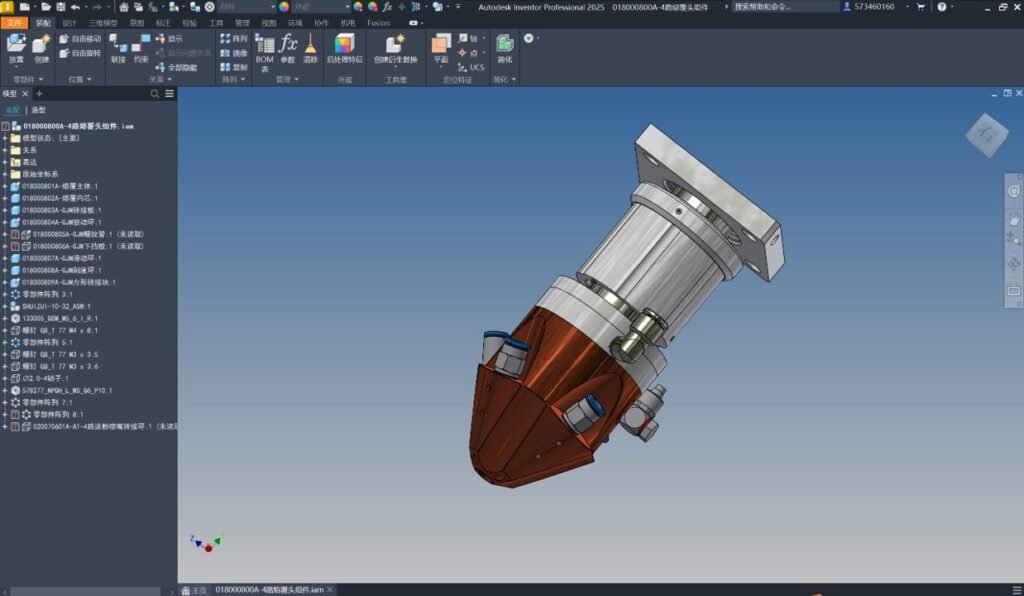
Figure(3)Autodesk Inventor Mechanical Design Interface
Structural Stability and Mechanical Precision
One of the primary considerations in laser head design is structural stability. The optical elements inside the laser head must remain precisely aligned with the optical axis to maintain beam quality and focusing accuracy.
Mechanical deformation caused by vibration, thermal expansion, or external mechanical stress can shift the optical path and degrade the laser spot quality.
To minimize these effects, high-rigidity materials such as aluminum alloys or copper alloys are commonly used in the housing structure. Precision machining and tight tolerance control are also required to maintain optical alignment during operation.
A stable mechanical framework ensures consistent laser processing performance even under demanding industrial conditions.
Thermal Management and Material Selection in High-Power Laser Heads
Thermal management is one of the most critical aspects of mechanical design in high-power laser processing heads. Based on my engineering experience, selecting appropriate materials for different structural components plays a key role in maintaining thermal stability and long-term reliability.
For example, the lens barrel or optical mount components are often manufactured from copper alloys such as T2 copper, which provides excellent thermal conductivity and allows heat generated near the optical elements to dissipate efficiently. The main housing of the laser head is typically made from aluminum alloys such as AL7075, which offer a good balance between strength, weight, and machining efficiency.
In areas that require higher structural strength or improved durability, stainless steel materials such as SUS304 are often used. For parts that require electrical insulation while still maintaining mechanical stability, PEEK (Polyether Ether Ketone) is a very practical material choice due to its excellent thermal resistance and insulating properties.
By combining these materials appropriately, it is possible to achieve a balanced mechanical structure that satisfies the requirements of strength, thermal performance, and electrical insulation.
Water Cooling Channel Design
In high-power laser heads, components that hold optical elements—such as the lens barrel or the surrounding mechanical body—typically require integrated water-cooling channels to remove heat generated during operation.
In many practical designs, the water-cooling interface is implemented using M5 threaded ports with an internal bore diameter of approximately 4.2 mm, or alternatively G1/8 threaded ports with an internal channel diameter of about 7 mm. These standardized interfaces allow convenient integration with industrial cooling systems.
Another important design consideration is the overall routing of the cooling channels. In many cases, the cooling water is guided first through regions that generate relatively less heat, and then through areas with higher thermal load before returning to the chiller unit for temperature control. This flow arrangement helps maintain stable temperature distribution across the laser head structure.
However, regardless of the cooling design, one fundamental engineering principle must always be respected: the system must never leak water. Water leakage inside a laser processing head can cause severe damage to optical components and electronic systems.
For sealing the cooling channels, fluororubber O-rings are commonly used because they offer excellent temperature resistance, chemical stability, and long-term sealing reliability in industrial environments.
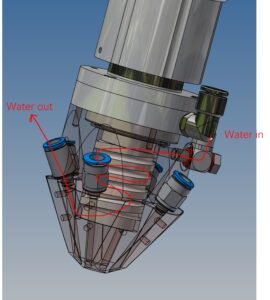
Figure(4)High Power Laser Head Water Cooling Channel Design
Protective Window Mounting Design
Industrial laser processing environments often contain dust, metal particles, and process spatter. To protect internal optical components, protective windows are installed near the laser output.
The mechanical design of the protective window holder must allow for:
Easy replacement
Reliable sealing
Accurate positioning
Many modern laser heads adopt a drawer-type or cartridge-type protective window design. This structure allows operators to quickly replace contaminated windows without disassembling the entire optical system.
Proper sealing using O-rings or gasket structures prevents dust and fumes from entering the optical chamber, ensuring long-term optical cleanliness.
Environmental Protection and Sealing Structure
Laser processing heads often operate in harsh industrial environments where dust, fumes, and metal particles are present.
A reliable sealing structure is essential to protect internal components.
Common protective design strategies include:
Positive pressure air protection
Sealed optical chambers
Protective covers for optical modules
Gas flow barriers
Positive pressure systems introduce clean air into the optical chamber, preventing contaminants from entering the system. This approach is widely used in high-power cutting and cladding heads.
Effective environmental protection significantly improves system reliability and reduces maintenance frequency.
Modular Mechanical Design
Modern laser heads are increasingly designed using modular engineering principles. Modular design simplifies maintenance, improves flexibility, and allows easier customization for different laser applications.
Typical modules in a laser processing head include:
Fiber interface module
Collimation module
Focusing module
Protective window module
Nozzle module
Each module can be independently serviced or replaced without affecting the rest of the system.
For example, changing the focusing module allows the system to adapt to different focal lengths or spot sizes without redesigning the entire laser head.
This modular architecture also supports easier upgrades and product variations.
Alignment and Assembly Accuracy
Precision alignment is essential for maintaining beam quality and focusing performance. Mechanical structures must ensure that all optical components remain centered along the optical axis.
Key alignment considerations include:
Precision positioning features
Adjustable mounts
Tight machining tolerances
Stable mounting interfaces
During assembly, careful alignment procedures are required to achieve optimal beam positioning. Once properly aligned, the mechanical structure must maintain this alignment under vibration and thermal load.
High assembly precision ensures consistent laser performance across different machines and applications.
Conclusion
Mechanical design plays a fundamental role in the performance and reliability of high-power laser processing heads. A successful design must balance structural rigidity, thermal management, environmental protection, and modularity.
By integrating precise mechanical engineering with advanced optical systems, modern laser heads can achieve high stability, efficient cooling, and long operational lifetimes.
As laser technology continues to evolve toward higher power and more demanding applications, robust mechanical design will remain a key factor in ensuring reliable industrial laser processing.